Major Economic Challenges Facing Pakistan
Introduction
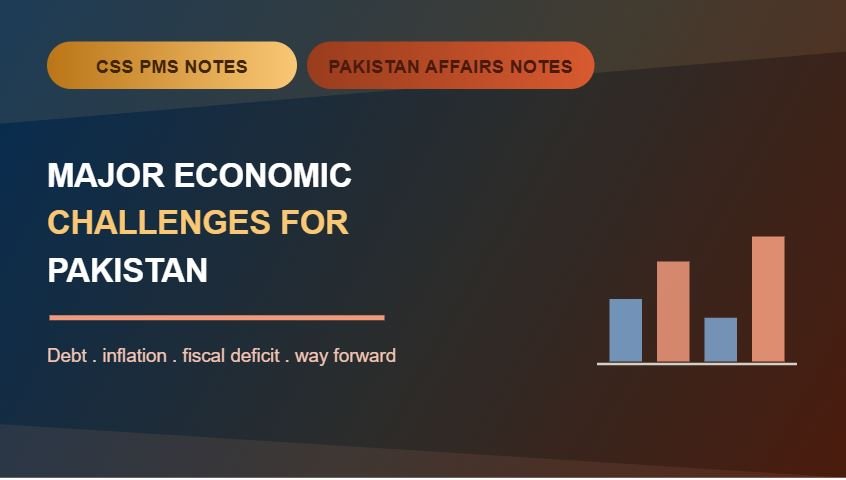
Pakistan’s economy has moved through repeated cycles of crisis and partial stabilization over the past decade — dwindling foreign reserves, high inflation, a persistent fiscal deficit, and recurring current account pressure have pushed the country back to the IMF for its 24th programme since 1958. While recent data shows meaningful stabilization, the underlying structural weaknesses — a narrow tax base, weak exports, low investment, and heavy debt servicing — remain largely unresolved, meaning short-term recovery has not yet translated into durable, structural strength.
Current Economic Snapshot (2026)
| Indicator | Value |
|---|---|
| Nominal GDP | ~$450 billion |
| GDP growth (FY2026) | 3.7% (highest in four years, below the 4.2% target) |
| Inflation (FY2026 average) | ~6–7% |
| Fiscal deficit | Narrowed sharply to ~0.7–1.1% of GDP |
| Current account | Near balance / brief surplus |
| Public debt-to-GDP | ~70% |
| SBP policy rate | 11.5% |
| Foreign reserves | ~$15–16 billion |
The improvement reflects tighter fiscal management, reforms under the ongoing IMF Extended Fund Facility, exchange rate stability, and resilience in agriculture and large-scale manufacturing — even as the economy absorbed shocks from the 2025 floods and a regional conflict in early 2026. Still, GDP growth of ~3.6–3.7% barely outpaces population growth (~2%), meaning per-capita income gains remain marginal for most citizens.
Structural Challenges
1. Chronic debt burden
Public debt sits at roughly 70% of GDP, and a large share of government expenditure continues to go toward debt servicing rather than development — a legacy of Pakistan’s historical reliance on external borrowing (public debt had already reached $179.8 billion by mid-2018, driven heavily by CPEC-related import growth and rupee depreciation).
2. Narrow tax base
Tax revenue has historically hovered around 10–13% of GDP — low relative to regional peers. Agriculture, despite contributing roughly a fifth of GDP, remains largely untaxed, while large segments of the informal economy escape the tax net entirely.
3. Weak, narrow export base
Pakistan’s exports remain concentrated in a handful of low-value-added sectors — textiles, rice, surgical goods, carpets, sports goods, and leather. This narrow export basket, combined with competition from lower-cost producers like Bangladesh and China, keeps the country structurally exposed to current account pressure.
4. Energy sector inefficiency
Persistent circular debt in the power sector, high generation costs, and unreliable supply continue to push industrial costs up and have driven some manufacturers to relocate operations to more competitive regional markets.
5. Low investment and low competitiveness
Investment as a share of GDP remains well below the regional average, and Pakistan has historically ranked poorly (107th of 140 on the Global Competitiveness Index in 2018) on measures of infrastructure, innovation capacity, and labor-market efficiency.
6. External vulnerability
The economy remains highly exposed to global shocks — oil price spikes, disrupted trade routes, and shifts in Gulf financing commitments (Saudi Arabia, UAE, and China remain key sources of bilateral support) — because domestic buffers (reserves, exports, tax revenue) are still comparatively thin.
7. Climate-related shocks
Recurring flooding — as seen again in 2025 — increasingly functions as a recurring fiscal and agricultural shock, not a one-off event, adding a climate-resilience dimension to Pakistan’s economic planning that didn’t feature as prominently in earlier economic strategy.
Recommendations
1. Broaden the tax base, not the tax burden
Rather than repeatedly taxing the same formal, documented sectors, Pakistan needs to bring agriculture, real estate, and retail into the tax net, while granting the FBR genuine operational independence to improve collection efficiency and taxpayer trust.
2. Diversify and modernize exports
Move beyond traditional low-value-added goods by investing in R&D, industrial modernization, and new export destinations (Central Asia, Eastern Europe), while addressing the energy-cost disadvantage that undercuts manufacturing competitiveness.
3. Fiscal decentralization
Devolving more authority and resources to provincial and district governments allows spending decisions to better match local needs, potentially improving efficiency in the use of already-scarce public resources.
4. Leverage the youth labor force
With a large working-age population, targeted skills training — aligned with both domestic and international labor market demand — could significantly boost remittance inflows (already around $38 billion annually) and formal employment.
5. Expand digital and financial inclusion
With mobile penetration now near-universal, digital platforms can extend banking, agricultural advisory, health, and education services to underserved populations, while supporting growth in IT and software exports.
6. Sustain macroeconomic discipline beyond the IMF programme
The recent improvement in fiscal and current account indicators has come largely under IMF-supervised reform. The durable test is whether Pakistan can sustain fiscal discipline, tax reform, and energy-sector restructuring after the current programme ends, rather than relapsing into the boom-bust pattern that has defined the last two decades.
7. Prioritize climate resilience in economic planning
Given the recurring cost of floods and extreme weather, climate adaptation — water management, resilient agriculture, disaster financing — needs to be treated as a core economic planning issue, not a peripheral one.
Conclusion
Pakistan’s economy has shown genuine signs of stabilization by 2026 — narrower deficits, more controlled inflation, and a steadier exchange rate — but these gains remain fragile and heavily dependent on continued IMF engagement and external financing from Gulf partners. Long-term resilience will depend on whether Pakistan can convert short-term stabilization into structural reform: a broader tax base, a more competitive export sector, and reduced dependence on repeated external bailouts.