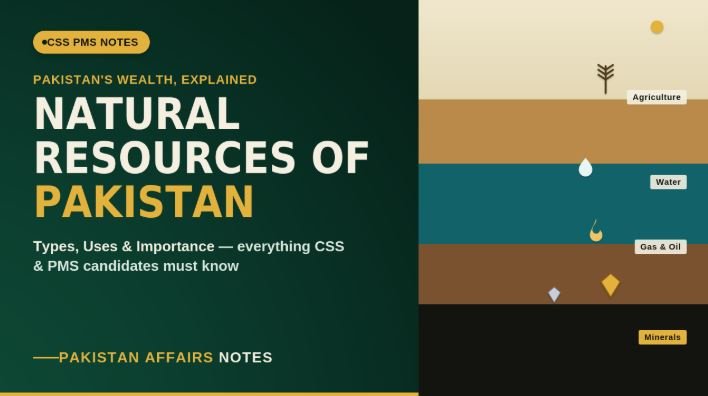
Natural Resources of Pakistan – Types, Distribution, Importance and Power Resources
Introduction
Pakistan is endowed with a wide variety of natural and mineral resources, including fertile agricultural land, rivers, forests, minerals, coal, natural gas, oil, gemstones and renewable energy potential. These resources play an important role in agriculture, industry, energy production, employment and exports.
Natural resources are materials and environmental assets that occur naturally and can be used to support human life and economic activity. They include land, water, forests, minerals, fossil fuels, wildlife and renewable sources of energy.
However, the availability of natural resources alone does not guarantee economic development. Their sustainable exploration, efficient management, value addition and transparent governance are equally important. Pakistan therefore needs to move from simply extracting raw materials toward resource-based industrialization and value-added production.
Pakistan’s strategic location between South Asia, Central Asia and the Middle East also provides opportunities for trade, regional connectivity and investment. Projects associated with the China-Pakistan Economic Corridor (CPEC) have further highlighted the importance of energy, infrastructure, minerals and regional connectivity.
Pakistan: A Country Rich in Natural Resources
Pakistan possesses diverse geographical features ranging from the Karakoram and Himalayan mountains in the north to the Indus River plain, deserts, plateaus and the Arabian Sea coastline. This geographical diversity contributes to the country’s resource base.
Major resources include:
- Coal
- Natural gas
- Oil
- Copper
- Gold
- Iron ore
- Rock salt
- Chromite
- Limestone
- Gypsum
- Marble
- Gemstones
- Forest resources
- Agricultural land
- Water resources
- Solar and hydropower potential
The country’s agricultural sector also depends heavily on its land and water resources. Major crops include wheat, rice, cotton, sugarcane and maize, while livestock, fisheries and horticulture contribute to rural livelihoods and the wider economy.
The major challenge is not simply the availability of resources but their efficient, sustainable and technologically advanced utilization.
Classification of Natural Resources in Pakistan
Natural resources can broadly be divided into the following categories:
1. Mineral and Energy Resources
These include:
- Coal
- Oil
- Natural gas
- Copper
- Gold
- Iron ore
- Chromite
- Rock salt
- Uranium
- Limestone
- Gypsum
2. Water Resources
Pakistan’s water resources include:
- Indus River
- Jhelum River
- Chenab River
- Ravi River
- Sutlej River
- Groundwater
- Glaciers
- Dams and reservoirs
- Arabian Sea
3. Biological Resources
These include:
- Forests
- Fisheries
- Wildlife
- Livestock
- Agricultural crops
4. Land Resources
Land supports:
- Agriculture
- Livestock
- Forestry
- Urban development
- Industry
- Infrastructure
Mining and Mineral Resources
Mining is an important component of Pakistan’s resource economy. The country has deposits of various metallic and non-metallic minerals distributed across different regions.
Important mineral-producing areas include Balochistan, Khyber Pakhtunkhwa, Punjab and Sindh.
Major minerals include:
- Coal
- Copper
- Gold
- Iron ore
- Chromite
- Rock salt
- Limestone
- Gypsum
- Marble
- Fluorspar
- Barite
- Gemstones
Mining can contribute to employment, exports, industrial development and government revenue. However, the sector faces challenges including inadequate technology, infrastructure constraints, environmental degradation, limited mineral processing and governance issues.
A major policy priority should therefore be value addition. Instead of exporting raw minerals, Pakistan can increase economic benefits by developing processing, refining and manufacturing industries.
Manufacturing and Natural Resources
Natural resources provide raw materials for Pakistan’s manufacturing sector. Agriculture, mining, energy and forestry are closely connected with industrial development.
Pakistan’s major industries include:
- Textile
- Sugar
- Cement
- Fertilizer
- Leather
- Food processing
- Pharmaceuticals
- Paper
- Steel
- Construction materials
The textile industry, for example, depends heavily on cotton, while cement production relies on mineral resources such as limestone and gypsum.
Thus, efficient resource management can help Pakistan develop domestic value chains, reduce dependence on imported inputs and create employment.
Major Natural Resources of Pakistan
1. Coal
Coal is an important energy and mineral resource in Pakistan. Significant coal deposits are found particularly in Thar, Sindh, while coal resources also exist in Balochistan, Punjab and Khyber Pakhtunkhwa.
Thar coal has attracted considerable attention because of its potential role in electricity generation and industrial development.
However, coal utilization also raises environmental concerns, including:
- Air pollution
- Greenhouse gas emissions
- Land degradation
- Water-use concerns
Therefore, coal development needs to be considered alongside Pakistan’s environmental commitments and transition toward cleaner energy.
2. Oil and Natural Gas
Oil and natural gas have historically been important components of Pakistan’s energy mix.
Important gas-producing areas include Sui in Balochistan, along with fields in Sindh and other parts of the country.
Natural gas is used for:
- Electricity generation
- Domestic consumption
- Fertilizer production
- Industrial processes
- Commercial activities
However, declining domestic production and rising energy demand have increased Pakistan’s dependence on imported energy. Expanding exploration, improving efficiency and developing alternative energy sources are therefore important for energy security.
3. Water Resources
Water is one of Pakistan’s most important natural resources. The Indus River System provides the foundation of the country’s agricultural economy.
Major rivers include:
- Indus
- Jhelum
- Chenab
- Ravi
- Sutlej
Water is essential for:
- Agriculture
- Drinking water
- Industry
- Hydroelectricity
- Fisheries
- Ecosystems
Pakistan also has significant glacier and snow resources in its northern mountainous regions.
However, water scarcity, climate change, inefficient irrigation, groundwater depletion and pollution pose serious challenges.
Efficient irrigation, water conservation, improved storage and better groundwater management are essential for Pakistan’s future water security.
4. Forest Resources
Forests provide timber, fuelwood, medicinal products, wildlife habitats and ecosystem services.
Pakistan’s forests include:
- Coniferous forests
- Riverine forests
- Mangrove forests
- Scrub forests
- Irrigated plantations
The mangrove forests along the Indus Delta are particularly important because they provide coastal protection, biodiversity and fisheries habitats.
Pakistan’s relatively low forest cover makes forest conservation and afforestation important national priorities.
5. Land Resources
Land is a fundamental resource for Pakistan’s agricultural economy.
Major agricultural products include:
- Wheat
- Rice
- Cotton
- Sugarcane
- Maize
- Fruits
- Vegetables
- Pulses
- Oilseeds
The Indus Basin irrigation system supports a large portion of agricultural production.
However, Pakistan faces problems such as:
- Soil degradation
- Waterlogging
- Salinity
- Land fragmentation
- Desertification
- Urban expansion
Sustainable land management is therefore essential for long-term food security.
6. Uranium
Uranium deposits have been identified in several areas of Pakistan. Uranium is a strategic mineral because of its use in the nuclear energy sector.
Its exploration and utilization require strict regulatory oversight, environmental safeguards and adherence to applicable national and international obligations.
7. Rock Salt
Pakistan is internationally known for its extensive rock salt deposits, particularly the Khewra Salt Mine in Punjab.
The Salt Range contains substantial salt resources, and Khewra has both economic and tourism significance.
Rock salt is used in:
- Food processing
- Chemical industries
- Pharmaceuticals
- Decorative products
- Industrial applications
Value-added salt products also provide opportunities for exports.
8. Copper and Gold
Pakistan has significant copper and gold resources, particularly in Balochistan.
The Reko Diq mineral deposit in Chagai district is one of the country’s most significant copper-gold resources. Other mineralized areas in Balochistan also contain important deposits.
Copper is essential for:
- Electrical equipment
- Electronics
- Construction
- Renewable energy technologies
- Industrial machinery
Developing mineral resources through responsible mining and domestic processing could increase their contribution to economic development.
9. Iron Ore
Iron ore deposits occur in several parts of Pakistan, including areas around Kalabagh, Chiniot and Balochistan.
Iron ore is an important raw material for the steel industry. Greater development of domestic mineral processing could help strengthen Pakistan’s industrial base and reduce dependence on imported raw materials.
10. Gemstones and Precious Stones
Pakistan is rich in gemstones and semi-precious stones. Khyber Pakhtunkhwa and the northern mountainous regions are particularly known for gemstone deposits.
Important gemstones include:
- Emerald
- Ruby
- Topaz
- Aquamarine
- Tourmaline
- Garnet
- Peridot
- Quartz varieties
The gemstone sector has considerable potential for exports and employment. Cutting, polishing, certification and branding can increase the value of Pakistani gemstones in international markets.
Power Resources of Pakistan
Pakistan’s major sources of electricity include:
- Hydropower
- Thermal power
- Nuclear power
- Solar energy
- Wind energy
The country’s future energy strategy increasingly requires diversification because dependence on imported fossil fuels can create pressure on foreign exchange reserves and energy security.
1. Hydroelectricity
Pakistan has considerable hydropower potential because of its mountainous terrain and river system.
Important hydropower projects include:
- Tarbela Dam
- Mangla Dam
- Ghazi-Barotha
- Neelum-Jhelum
- Dasu
- Diamer-Bhasha
Hydropower provides electricity while also supporting water management and irrigation objectives.
However, hydropower projects can involve environmental, social and resettlement concerns. Proper planning and impact assessment are therefore necessary.
2. Thermal Electricity
Thermal power plants use fuels such as:
- Natural gas
- Imported LNG
- Oil
- Coal
Thermal generation has historically constituted a major part of Pakistan’s electricity supply.
Its major challenge is the cost and availability of fuel. Dependence on imported fuels can also expose the economy to international price fluctuations.
3. Solar Energy
Pakistan has excellent solar-energy potential because of its high solar radiation and large areas with substantial sunshine.
Solar energy can help:
- Reduce dependence on fossil fuels
- Improve energy access
- Lower electricity costs in suitable applications
- Support rural electrification
- Diversify the national energy mix
The growth of distributed solar systems has also created new opportunities for households, businesses and agricultural users.
4. Wind Energy
Pakistan has considerable wind potential, particularly in the Jhimpir-Gharo wind corridor in Sindh.
Wind energy can diversify electricity generation and reduce dependence on fossil fuels.
5. Nuclear Energy
Nuclear power contributes to Pakistan’s electricity generation through nuclear power plants operated under the country’s regulatory framework.
Nuclear energy can provide relatively stable electricity generation, but it requires high standards of safety, security, regulation and waste management.
Important Ore Deposits and Their Formation
Ore deposits are naturally occurring concentrations of minerals that can potentially be extracted economically.
They can form through several geological processes.
1. Magmatic Deposits
These form when minerals crystallize from cooling magma. Examples can include deposits containing nickel, chromium or copper.
2. Hydrothermal Deposits
Hot, mineral-rich fluids move through cracks in rocks and deposit minerals as temperature and pressure conditions change. Gold, silver and copper can occur in such systems.
3. Sedimentary Deposits
Minerals accumulate through sedimentation or chemical precipitation. Iron and phosphate deposits can occur through sedimentary processes.
4. Metamorphic Deposits
Existing rocks are altered by heat, pressure and chemically active fluids, potentially concentrating useful minerals.
5. Placer Deposits
Heavy minerals can accumulate through the action of rivers, streams, waves and gravity. Gold is a classic example.
6. Seafloor Deposits
Hydrothermal activity on the ocean floor can create mineral-rich deposits containing metals such as copper and zinc.
7. Lateritic Deposits
In warm, humid climates, intense weathering can remove soluble materials and concentrate elements such as nickel and Aluminium in the remaining soil and rock.
Understanding the geological formation of ores is important for mineral exploration and sustainable mining.
Economic Importance of Natural Resources
Natural resources contribute to Pakistan’s economy in several ways:
1. Employment Generation
Mining, agriculture, forestry, fisheries and energy projects create direct and indirect employment.
2. Industrial Development
Minerals and agricultural products provide raw materials for industries.
3. Energy Security
Domestic energy resources can reduce dependence on imported fuels.
4. Export Earnings
Minerals, agricultural products, textiles and processed goods can contribute to foreign exchange earnings.
5. Regional Development
Resource-based projects can improve infrastructure and economic activity in less-developed regions.
6. Government Revenue
Royalties, taxes and other revenues from resource industries can contribute to public finances.
Major Challenges in Resource Management
Despite its resource potential, Pakistan faces several challenges:
- Poor resource governance
- Illegal mining
- Outdated mining technology
- Lack of value addition
- Water scarcity
- Deforestation
- Environmental degradation
- Energy shortages
- Limited infrastructure
- Political and regulatory uncertainty
- Lack of reliable geological data
- Weak enforcement of environmental standards
The solution is not simply greater extraction. Pakistan needs sustainable resource governance, modern technology, transparent regulation and greater investment in processing and value addition.
Way Forward
Pakistan can improve the contribution of natural resources to economic development through the following measures:
- Promote value-added industries rather than exporting raw materials.
- Modernize mining technology and improve geological surveys.
- Strengthen environmental regulations and monitoring.
- Improve water-use efficiency, particularly in agriculture.
- Expand renewable energy such as solar and wind.
- Encourage responsible foreign and domestic investment.
- Develop skilled human resources for mining, engineering and resource management.
- Improve infrastructure in resource-rich areas.
- Increase transparency in licensing, royalties and contracts.
- Promote local participation so resource-producing regions receive sustainable economic benefits.
Conclusion
Pakistan possesses a diverse and potentially valuable natural-resource base, ranging from water, fertile land and forests to coal, natural gas, copper, gold, salt, iron ore and gemstones. These resources can support agriculture, industrialization, employment, energy security and exports.
However, natural wealth becomes an economic asset only when it is efficiently managed, sustainably developed and converted into value-added products. Pakistan therefore needs a long-term resource strategy based on modern technology, environmental protection, transparent governance, skilled human resources and industrial value addition.
For CSS and PMS aspirants, Pakistan’s natural resources are particularly important because the topic connects economy, energy security, agriculture, environment, mining, CPEC, industrialization and sustainable development.