
Imagine living in a country where your voice truly matters — where you can vote, criticize leaders, and protest without fear. Now picture another country where one man or one party controls everything, dissent is silenced, and citizens are expected to obey without question.
These two political worlds define the ongoing struggle between democracy and authoritarianism. In 2025, this debate is more urgent than ever.
What is Democracy?
Definition: Democracy is a system of government where power belongs to the people.
They elect their leaders through free and fair elections, and those leaders are accountable to the citizens.
As Abraham Lincoln famously said:
“Democracy is government of the people, by the people, for the people.”
Key Features of Democracy
- Free & fair elections
- Rule of law (laws apply equally to all)
- Protection of human rights
- Independent judiciary and legislature
- Transparency and accountability
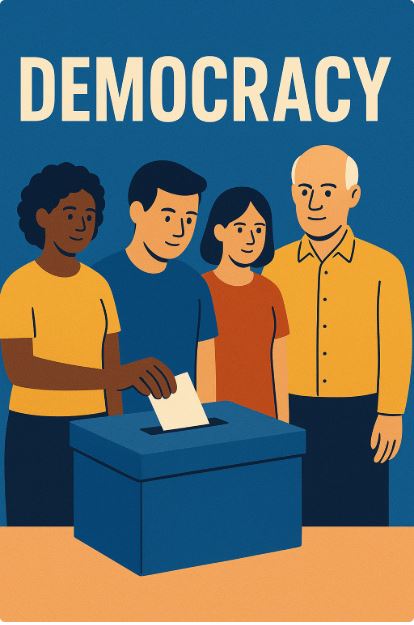
A ballot box with diverse citizens casting votes.
What is Authoritarianism?
Definition: Authoritarianism is a political system where power is concentrated in the hands of a single leader or a small group. Citizens have little or no say in decision-making.
Key Features of Authoritarianism
- Controlled or no real elections
- Limited political freedoms
- State-controlled media
- Strong central authority
- Suppression of opposition
Illustration of a leader addressing a silent, uniform crowd.

Democracy vs Authoritarianism: Key Differences
| Aspect | Democracy | Authoritarianism |
|---|---|---|
| Source of Power | Citizens via elections | Leader / elite group |
| Political Freedom | High (speech, protest, press) | Limited or absent |
| Rule of Law | Applies equally to all | Often ignored |
| Media | Independent, free press | State-controlled |
| Decision-Making | Slow but inclusive | Fast, centralized |
| Stability | Sometimes unstable | Appears stable but fragile |
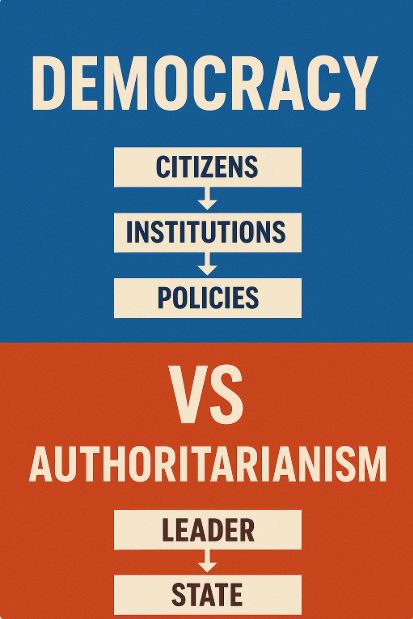
Infographic :
Flowchart comparing decision-making in democracy (citizens → institutions → policies) vs authoritarianism (leader → state → policies).
Pros and Cons of Democracy
✅ Advantages
- Protects freedoms of speech and religion
- Allows peaceful transfer of power
- Encourages diversity and innovation
- Provides legitimacy through citizen choice
❌ Disadvantages
- Slow decision-making process
- Political instability possible (coalitions, protests)
- Expensive election processes
- Risk of corruption in political campaigns
Pros and Cons of Authoritarianism
✅ Advantages
- Quick decision-making
- Can maintain short-term stability
- Easier to implement long-term projects (no election cycles)
❌ Disadvantages
- Suppresses freedom of expression
- No checks on abuse of power
- Citizens lack real participation
- Fragile legitimacy — often dependent on force
Case Studies: Democracy vs Authoritarianism in Action
1. United States (Democracy)
Despite polarization, strong institutions (Congress, Supreme Court, free media) keep leaders accountable.
2. China (Authoritarianism)
One-party rule has brought rapid economic growth, but freedom of speech, internet access, and dissent remain tightly controlled.
3. Pakistan (Hybrid System)
A mix of democracy and authoritarianism — with periods of military rule and democratic governments. Challenges include corruption, weak institutions, and civil-military tensions.
4. Russia (Authoritarianism)
Elections exist, but real power lies with the ruling party and leader. Opposition is often silenced, media is state-controlled, and dissent is punished.
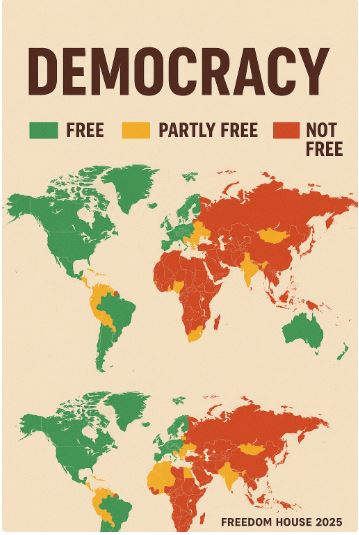
World map showing countries categorized as “Free, Partly Free, Not Free” (source: Freedom House 2025).
Trends in 2025
- 🌍 Global Democratic Backsliding: Democracies in countries like Turkey, Hungary, and India show declining freedoms.
- 💻 Technology & AI: Democracies use AI for digital participation, while authoritarian regimes use it for mass surveillance.
- ⚖️ Populism Rising: Leaders in democratic nations increasingly use authoritarian tactics to consolidate power.
- 🌐 Global Divide: Western nations defend democracy, while BRICS powers (China, Russia) promote centralized models.
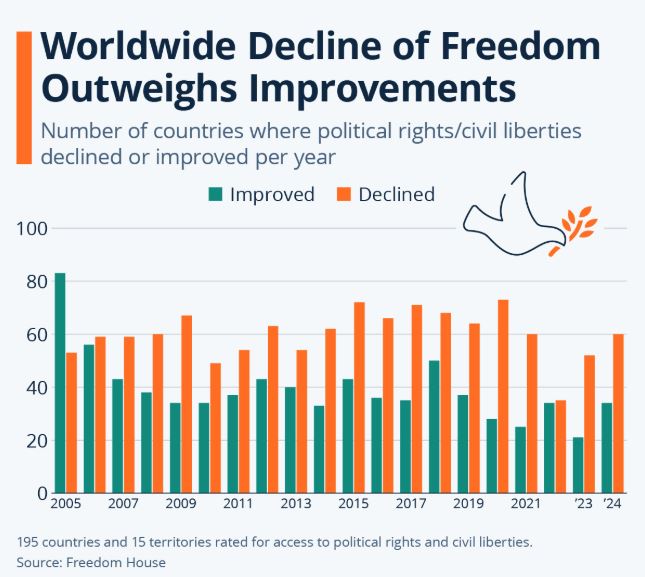
Freedom House 2025 report showing global decline in democratic freedoms.
Conclusion: The Future of Governance
The battle between democracy and authoritarianism is not just about institutions — it’s about how people want to live. Democracy offers freedom and representation but struggles with instability. Authoritarianism offers order and speed but at the cost of freedom.In 2025, the choice many societies face is stark: Will citizens trade freedom for stability, or will they defend their democratic voice? The answer will define the future of global politics.
FAQs
Q1: Which system is better, democracy or authoritarianism?
It depends on values. Democracy prioritizes freedom and participation, while authoritarianism prioritizes control and efficiency.
Q2: Why do democracies sometimes fail?
Weak institutions, corruption, poor governance, and economic crises often weaken democracies.
Q3: Can a country be partly democratic and partly authoritarian?
Yes — such systems are called hybrid regimes (e.g., Pakistan, Turkey).
Q4: Which system is more common today?
According to Freedom House 2025, more than 70 countries are authoritarian or partly free, while fewer than 90 are fully democratic.
📌 Sources (Authentic)
- Freedom House Report 2025
- Economist Intelligence Unit – Democracy Index 2025
- Samuel P. Huntington, The Third Wave
- World Bank Governance Indicators