
1. What is Realism?
Realism is a theory of international relations. It says the world is dangerous and competitive. States care only about their own survival and power.
Key Ideas:
- States are the main actors in world politics.
- The world has no central government — it is anarchic.
- Every state looks after its own interests — called ‘self-help’.
- Military power is the most important tool.
- War is always possible and must be prepared for.
Real-Life Example: The Cold War (USA vs USSR) is a classic example. Both superpowers built massive armies, formed military alliances (NATO vs Warsaw Pact), and competed for global dominance — purely out of national self-interest.
“The strong do what they can; the weak suffer what they must.” — Thucydides
2. What is Liberalism?
Liberalism believes countries can cooperate. It says trade, institutions, and democracy lead to peace. The world does not have to be a battlefield.
Key Ideas:
- Countries that trade with each other are less likely to fight.
- International institutions (like the UN) promote peace.
- Democracies rarely go to war with each other — Democratic Peace Theory.
- Human rights and rule of law matter in global affairs.
- Cooperation and diplomacy can solve conflicts.
Real-Life Example: The European Union (EU) is the best example. After two devastating World Wars, European countries chose cooperation over conflict. They created shared institutions, open borders, and a common market — proving liberal ideas can work.
“Perpetual peace is possible through a federation of free states.” — Immanuel Kant
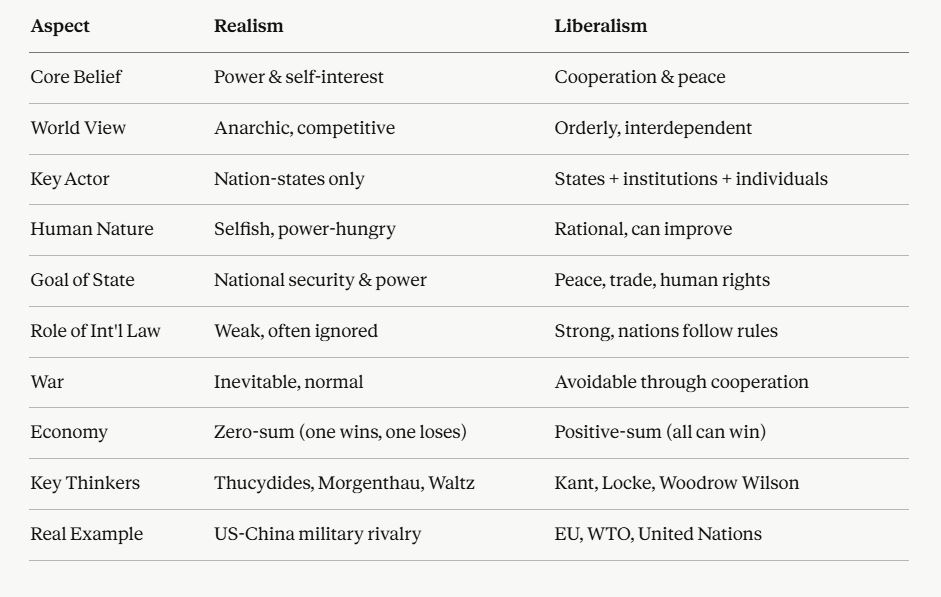
3. Realism vs. Liberalism — Quick Comparison
4. Types — Quick Overview
Types of Realism:
- Classical Realism — Human nature is selfish (Morgenthau)
- Structural/Neo-Realism — System structure causes conflict (Waltz)
- Offensive Realism — States always try to gain more power (Mearsheimer)
Types of Liberalism:
- Institutional Liberalism — International organizations keep peace
- Commercial Liberalism — Free trade prevents war
- Republican/Democratic Liberalism — Democracies don’t fight each other
- Neo-Liberalism — Cooperation is possible even without full trust
5. Criticisms
Against Realism:
- Ignores the role of international institutions and law.
- Cannot explain why many countries cooperate peacefully.
- Overlooks economics, culture, and identity.
Against Liberalism:
- Too idealistic — ignores hard power realities.
- International institutions often fail (e.g., UN in conflicts).
- Benefits of trade are not always equally shared.
6. Exam Tips
- Realism = Power, Self-interest, Anarchy, War
- Liberalism = Peace, Trade, Institutions, Cooperation
- Realism is “what IS” — it describes the world as it is.
- Liberalism is “what COULD BE” — it imagines a better world.
- Realism = Pessimist. Liberalism = Optimist.
- Both are still relevant — modern IR uses both lenses together.
7. Frequently Asked Questions (FAQs)
Q: What is the main difference between Realism and Liberalism?
A: Realism believes states compete for power and war is normal. Liberalism believes states can cooperate and create lasting peace through trade and institutions.
Q: Which theory is more relevant today?
A: Both are relevant. Realism explains military rivalries (US-China), while Liberalism explains multilateral cooperation (WTO, climate agreements, UN).
Q: Who are the key thinkers of Realism?
A: Thucydides (ancient), Niccolo Machiavelli, Hans Morgenthau (Classical Realism), Kenneth Waltz (Neo-Realism), and John Mearsheimer (Offensive Realism).
Q: Who are the key thinkers of Liberalism?
A: Immanuel Kant, John Locke, Woodrow Wilson (proposed the League of Nations), and Robert Keohane (Neo-Liberalism).
Q: What is the ‘Democratic Peace Theory’?
A: It is a liberal idea that says democracies rarely (if ever) go to war with each other. They prefer diplomacy and negotiation over conflict.
Q: Is the United Nations an example of Realism or Liberalism?
A: The United Nations is a liberal institution. It promotes cooperation, human rights, and peaceful resolution of disputes. However, its limitations (veto power of P5) also reflect realist thinking.
Q: Can Realism and Liberalism coexist?
A: Yes. Most real-world foreign policy mixes both. A country may build a strong military (Realism) while also joining trade agreements and international bodies (Liberalism).
Q: What is ‘anarchy’ in international relations?
A: Anarchy means there is no world government. No single authority rules over all countries. Realists see this as the cause of conflict. Liberals believe institutions can manage this anarchy.