Relationship between Cells, Tissues and Organs
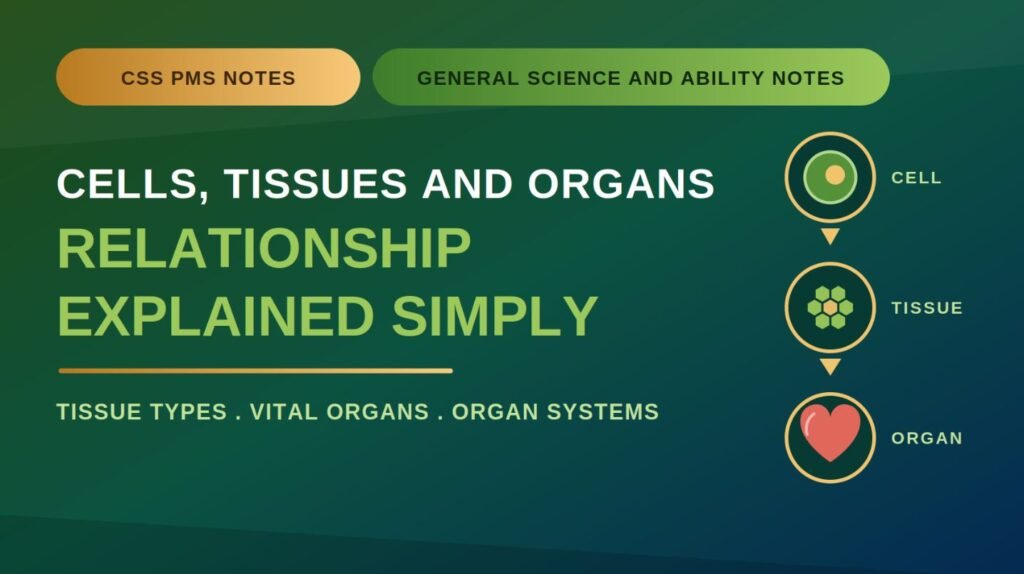
The human body is organized like a well-run city. Individual units do specialized jobs, and the units cooperate to keep everything running. Understanding how cells, tissues and organs are related is the first step to understanding human biology. Cells combine to form tissues, tissues combine to form organs, and organs combine to form organ systems. This guide explains each level of organization, with examples and the latest scientific research.
The Levels of Organization in the Human Body
Biologists describe the body as a hierarchy:
Cells → Tissues → Organs → Organ Systems → Organism
Each level is built from the one below it and depends on it. If cells fail, tissues suffer; if tissues are damaged, the organ cannot do its job properly. This is why a single disease can sometimes affect the whole body.
Cells: The Basic Units of Life
The cell is the simplest unit of life. Some organisms, such as bacteria, consist of just one cell. The human body is vastly more complex. Estimates suggest it contains roughly 30 to 37 trillion human cells, not counting the huge number of bacteria that live in the digestive tract. Scientists believe there are about 200 distinct types of cells in the body, including:
- Red blood cells, which carry oxygen
- Nerve cells (neurons), which transmit signals
- Muscle cells, which contract to produce movement
- Epithelial cells, which form protective linings
- Immune cells, which defend against infection
Although cells differ in shape and function, most contain a nucleus, cytoplasm, and a cell membrane, and they all need energy to survive.
Tissues: Groups of Cells Working Together
A tissue is a group of similar cells organized to perform a specific function. The human body has four basic types of tissue.
1. Epithelial Tissue
Epithelial tissue covers the outside of the body and lines organs and body cavities. It protects, absorbs, and secretes. Skin and the lining of the intestine are examples.
2. Muscle Tissue
Muscle cells are sometimes called “excitable” because they respond to signals by contracting. This produces movement, from walking to the beating of the heart. There are three kinds: skeletal, smooth, and cardiac muscle.
3. Nervous Tissue
Nervous tissue conducts electrical impulses and carries signals between the brain, spinal cord, and the rest of the body. It makes thinking, sensation, and coordinated movement possible.
4. Connective Tissue
Connective tissue supports, binds, and protects the body. It is the most varied tissue type, and it includes bone, cartilage, fat, and even blood.
Organs: Where Tissues Combine
An organ is made of two or more tissues working together as a single unit with a distinct structure and function. The heart is a good example. It contains all four tissue types: muscle tissue to pump blood, connective tissue to give structure and form the valves, epithelial tissue to line its chambers, and nervous tissue to control its rhythm.
The body is often described as having around 78 organs. Five are considered vital for survival:
- Brain: controls thought, movement, and body functions
- Heart: pumps blood throughout the body
- Lungs: supply oxygen and remove carbon dioxide
- Kidneys: filter blood and balance fluids
- Liver: processes nutrients and removes toxins
The skin is the largest organ in the human body, typically weighing around 8 pounds (about 3.5 to 4 kg) in an average adult.
Organ Systems: Organs That Cooperate
Even separate organs rarely work alone. Groups of organs form organ systems, such as the digestive, respiratory, circulatory, nervous, and immune systems. For example, the lungs, heart, and blood vessels cooperate to deliver oxygen to every cell. This teamwork is what keeps the body in balance, a state known as homeostasis.
Mapping Human Cells: The Tabula Sapiens Atlas
Modern science is revealing how cells, tissues and organs are connected in far greater detail than ever before.
- The Human Cell Atlas. In 2022, the international Human Cell Atlas consortium reported detailed maps of more than a million individual cells across 33 organs, described as the most comprehensive cross-tissue cell atlases to date. The goal is to chart every cell type in the healthy body, rather than looking at one organ at a time. eurekalert
- Tabula Sapiens. One major part of this effort was the Tabula Sapiens atlas, a reference atlas of nearly 500,000 cells from 24 different tissues and organs, many from the same donor. Because several organs came from the same person, scientists could compare cell types fairly across tissues. A later version expanded the project to 28 tissues collected across 24 donors. nihczbiohub
- Immune cells. Researchers studied single immune cells from deceased donors to see how they behave in different tissues. They also examined fetal tissues to build a map of the developing immune system between conception and birth.
- Disease genes. The mapping also identified which cells express genes linked to conditions such as muscular dystrophy and heart disease, which could help researchers understand where diseases begin.
Why Understanding Cells, Tissues and Organs Matters
Knowing how these levels connect is essential in medicine and science. Doctors diagnose disease by looking for changes at the cell and tissue level, such as in a biopsy. Cancer, for example, begins when cells grow out of control. Cell atlases help researchers design targeted treatments, improve organ transplants, and understand why some diseases affect certain organs only.
Quick Revision Table
| Level | Definition | Example |
|---|---|---|
| Cell | Basic unit of life | Red blood cell, neuron |
| Tissue | Group of similar cells with one function | Muscle tissue |
| Organ | Two or more tissues working as a unit | Heart, liver |
| Organ system | Group of organs with a shared role | Digestive system |
Frequently Asked Questions
What is the relationship between cells, tissues and organs?
Cells group together to form tissues, tissues combine to form organs, and organs work together as organ systems.
What are the four types of tissue?
Epithelial, muscle, nervous, and connective tissue.
Which are the five vital organs?
The brain, heart, lungs, kidneys, and liver.
What is the largest organ in the human body?
The skin.
What is the Tabula Sapiens?
It is a multi-organ human cell atlas that maps the cell types found in different tissues from the same donors.
Conclusion
The relationship between cells, tissues and organs is the foundation of human biology. Cells are the building blocks, tissues are teams of similar cells, and organs are teams of tissues, all coordinated within organ systems. With projects like the Human Cell Atlas and Tabula Sapiens, scientists are mapping this hierarchy in unprecedented detail, which promises better diagnosis and treatment of disease.