The Population Bomb: How Pakistan’s Population Growth Can Erupt Like an Atomic Bomb
Introduction
Unchecked population growth is one of the most urgent — and most ignored — challenges facing Pakistan today. Despite its scale, no government has treated it as the national emergency it actually is. From economic strain to environmental degradation and stalled development, Pakistan’s population is expanding at a rate the country simply cannot sustain.
Successive governments have never fully grasped the depth of the crisis. Public discourse around population growth remains narrow and reactive, when the issue actually demands a broad, structural response spanning health, education, religion, and economic policy.
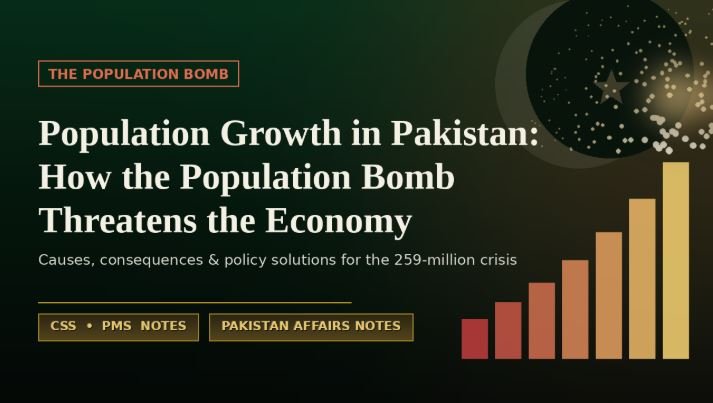
Pakistan’s population stood at just 34.4 million at independence in 1947. By 2025, it had reached roughly 255 million people, growing at around 1.57% a year, and by 2026 the figure has crossed 259 million, making Pakistan home to 3.12% of the world’s population. If this trajectory holds, demographic models put Pakistan’s population somewhere between 355 and 370 million by 2050 — a number that would put unbearable pressure on land, water, jobs, and public services that are already stretched thin. worldometersworldometer
Globally, the picture is just as alarming. The world’s population passed 8 billion in 2022 and continues climbing with no sign of slowing. For Pakistan specifically, the numbers are sobering: the growth rate currently sits at 1.6%, with roughly 36% of the population under 15 and just 4.4% over 65 — a demographic structure that could be a “youth dividend” if managed well, or a ticking time bomb if it isn’t. population-pyramid
Pakistan’s Population Growth: The Numbers
Pakistan’s population growth rate remains far higher than regional peers like India, Bangladesh, and Sri Lanka. In 1950, Pakistan had a population of around 35 million and ranked 14th globally. Today, with a population of roughly 259 million and a 5th-place global ranking, Pakistan has overtaken Brazil, Nigeria, Bangladesh, Russia, Japan, and South Korea — trailing only China, India, the United States, and Indonesia. worldometers
The country’s total fertility rate stands at 3.4 births per woman in 2026 — well above the replacement level of 2.1 — meaning the population will keep growing for decades even if fertility rates begin to fall today. The median age is just 20.8 years, underscoring how young — and fast-growing — the country’s population really is.
Pakistan’s Global Standing
In terms of land area, Pakistan ranks 34th in the world, occupying just 0.6% of the planet’s landmass — yet it ranks around 150th on the Human Development Index. Population density has already reached 336 people per square kilometer, and urbanization is accelerating fast, with roughly 90 million people — about 35% of the population — now living in cities. Karachi alone is home to over 21 million people, followed by Lahore at more than 15 million. On average, each Pakistani family still has more than three children — a fertility rate that keeps the “population bomb” ticking louder every year. Pakistan Demographics +2
A Serious Threat to Socioeconomic Stability and Security
With weak human development indicators across the board, this population explosion poses one of the most serious threats to Pakistan’s socioeconomic stability and national security. With roughly 60–65% of the population under 30 and job creation lagging far behind, the country is sitting on a demographic disaster in slow motion. What’s most alarming is how little attention this crisis receives from political leaders, who remain consumed by short-term power struggles instead.
Despite the scale of the problem, population growth rarely features in mainstream political debate. It’s telling that the national census — a constitutional obligation meant to be held every ten years — was delayed by nearly two decades and only completed after intervention by the Supreme Court.
This isn’t a uniquely Pakistani problem — the world is grappling with overpopulation too, with the global population now above 8 billion. After terrorism, unchecked population growth is arguably the biggest challenge facing humanity today. The phrase “the population bomb is ticking” has become a cliché precisely because it’s true, and Pakistan faces a particularly urgent version of this challenge as it tries to balance economic development with poverty reduction.
At the current 2.4% historical growth trajectory, Pakistan’s population would double within roughly three decades, potentially making it the third most populous country on Earth — all while usable land area shrinks due to urban expansion and housing development.
Root Causes of Pakistan’s High Population Growth
- High fertility rates combined with low contraceptive use
- Significant unmet need for family planning services
- Declining mortality rates without a corresponding drop in birth rates
- Cultural norms around early marriage
- Strong preference for male children
- Widespread poverty and illiteracy, particularly among women
- Limited women’s empowerment and economic participation
- Religious and cultural taboos around family planning
- Lack of recreational and educational alternatives, especially in rural areas
Why Government Population Policies Have Failed
Pakistan’s population welfare Programme is one of the oldest of its kind in the world — yet it has consistently underperformed compared to countries like Bangladesh and Indonesia that started from a similar position. Poor implementation is the core problem: contraceptive prevalence, instead of rising, has actually declined and now sits at just 30–35%.
Compounding this, the government has no reliable monitoring system to track health center performance or population data in real time. Meanwhile, both ruling and opposition parties have consistently sidelined the issue in favor of more visible, “safer” political topics like load-shedding and corruption. That’s really the core problem: population growth has become socially and religiously taboo to even discuss openly, let alone legislate on.
Pakistan isn’t alone as a Muslim-majority country facing this challenge. Iran and Bangladesh both succeeded in bringing conservative religious leaders into the conversation, using incentives and religious edicts to drive family planning adoption. Their experience proves the problem is solvable — it just requires political will.
Unfortunately, public spending on education remains minimal, and education reform ranks low on the government’s list of priorities, making the uphill battle even steeper. Long-term structural change will take time, but immediate, practical steps exist: free contraceptive distribution, expanded access to sterilization, and religious edicts (fatwas) supporting family planning — all achievable with the right institutional backing.
If this already unsustainable growth rate is allowed to continue unchecked, sustainable economic growth will remain out of reach. While much of the world has seen fertility rates decline, Pakistan’s growth rate has remained stubbornly high — among the highest in the region. It’s a genuinely alarming trend, and one that still isn’t getting the attention it deserves.
The Toll on Agriculture and Natural Resources
Agriculture is one of the sectors hit hardest by rapid population growth. Roughly 70% of Pakistan’s population depends on agriculture for their livelihood, yet overpopulation is actively undermining agricultural output. More people means smaller, more fragmented farms — and smaller farms mean lower productivity per household. The same pressure is being felt in forests and freshwater supplies. Pakistan is already a water-stressed country with insufficient dams and reservoirs to secure its future water needs.
To reach high-middle-income status within the next 30 years, Pakistan will need to cut its population growth rate roughly in half — otherwise, population growth itself will remain the single biggest barrier to prosperity.
Pakistan effectively stands at a fork in the road. One path leads toward stabilized growth and rising prosperity; the other leads toward a population that could reach 400+ million by 2047 if current trends hold — nearly double the size recorded in the most recent census.
Recommendations: Defusing the Population Bomb
- Introduce two-child policy incentives — Consider tax-based incentives or disincentives tied to family size, implemented carefully and equitably.
- Raise the legal marriage age — Minimum age of 22 for women and 25 for men, strictly enforced.
- Integrate population education into school curricula — From primary school through university, covering the economic and environmental impact of overpopulation.
- End financial incentives tied to family size — Remove any policy that rewards parents financially for having more children.
- Expand access to contraception — Make safe, affordable contraceptive options available to both men and women, starting at the grassroots level with a clear, strategic national plan.
- Integrate family planning into mainstream healthcare — Make it a standard part of primary health services, not a separate, stigmatized program.
- Empower local and provincial governments — Give them a stronger operational role in delivering family planning services.
- Strengthen NGO and medical involvement — Improve transparency and efficiency in how family planning aid is disbursed.
- Engage men directly — Family planning campaigns should actively involve and educate men, not target women alone.
- Invest in women’s status and opportunity — Better access to education, healthcare, and economic participation for women.
- Treat this as a national crisis — Population growth should be elevated to the same policy priority as the economy or security.
- Leverage media, especially in rural areas — Use radio, TV, and digital platforms to shift cultural attitudes toward smaller families.
- Involve religious scholars (Ulema) and NGOs — Build religious buy-in the way Iran and Bangladesh did.
- Engage landlords and rural influencers — Use their social standing to promote family planning in agricultural communities.
Conclusion
Pakistan’s population is not just a statistic — it’s the single variable that will determine whether the country can achieve economic stability, food security, and social cohesion in the coming decades. The window to act is narrowing. Without a coordinated national strategy — one that brings together government, religious leadership, media, and civil society — the “population bomb” won’t just tick. It will detonate.