
CRIPPS MISSION PLAN 1942
Introduction
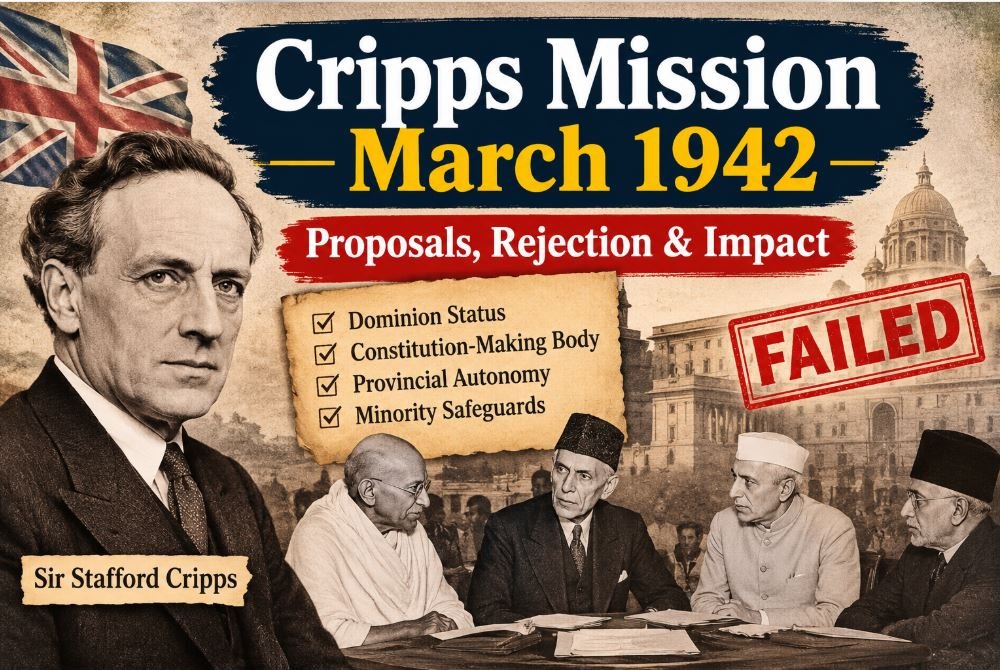
The Cripps Mission Plan 1942 was an important constitutional proposal introduced by the British Government during the Second World War to secure Indian political cooperation and support for the Allied war effort. The mission was headed by Sir Stafford Cripps, a prominent member of the British War Cabinet, who arrived in India in March 1942.
The mission proposed granting Dominion Status to India after the war and establishing a constitution-making body to frame a new constitution. It also introduced the provision that provinces could choose not to join the proposed Indian Union. However, the proposals failed to satisfy the major political parties, particularly the All-India Muslim League and the Indian National Congress, and were ultimately rejected.
Historical Background of the Cripps Mission Plan 1942
The international political situation changed dramatically during the Second World War (1939–1945). Japan entered the war in December 1941 and rapidly expanded its military operations across Southeast Asia. After occupying several territories, Japanese forces captured Burma in 1942 and advanced towards India’s eastern borders.
These developments created serious concerns for the British Government because India was strategically important for the Allied war effort. Britain urgently needed the political cooperation and military support of the Indian people.
Furthermore, the United States and other Allied powers encouraged Britain to address India’s constitutional and political demands. Under these circumstances, the British Government decided to send a special mission to India to negotiate with Indian political leaders.
Cripps Mission (March 1942)
The British Government appointed a delegation headed by Sir Stafford Cripps, a prominent member of the British War Cabinet, to discuss constitutional reforms with Indian political leaders.
The mission arrived in New Delhi on 23 March 1942. During its stay, Sir Stafford Cripps held discussions with prominent Indian leaders, including Quaid-e-Azam Muhammad Ali Jinnah, Mahatma Gandhi, Jawaharlal Nehru and Maulana Abul Kalam Azad.
On 29 March 1942, Cripps publicly presented the British Government’s constitutional proposals. The main objective was to obtain Indian cooperation in the Second World War by offering a framework for India’s future political and constitutional development.
However, serious differences emerged between the British Government and Indian political parties over the proposed constitutional arrangements, particularly the questions of defence, independence, provincial autonomy and the future political structure of India.
The negotiations failed to produce an agreement, and Sir Stafford Cripps left India in April 1942.
Important Terms and Proposals of the Cripps Mission Plan 1942
The major proposals of the Cripps Mission Plan 1942 were as follows:
1. Dominion Status After the War
India would be granted Dominion Status after the conclusion of the Second World War. The proposed Indian Dominion would have the right to determine its relationship with the British Commonwealth.
2. Formation of a Constitution-Making Body
A constitution-making body would be established immediately after the war to frame a new constitution for India.
3. Representation of British Indian Provinces
The members of the constitution-making body representing British Indian provinces would be elected by the lower houses of provincial legislatures through proportional representation.
4. Representation of Princely States
The princely states would also participate in the constitution-making process. Their representatives would be nominated by their respective rulers rather than directly elected by the people.
5. Right of Non-Accession
Any province that did not wish to join the proposed Indian Union would have the right to remain outside it. Such a province could retain its existing constitutional position or establish a separate constitution with a status equivalent to that of the proposed Indian Union.
This provision was particularly significant because it introduced the possibility of provincial separation from a future Indian Union.
6. Protection of Minorities
The proposed constitutional settlement would include safeguards for the protection of racial and religious minorities. A treaty between the British Government and the constitution-making body would provide guarantees regarding these protections.
7. British Control Over Defence
During the critical period of the Second World War, the British Government would retain responsibility for and control over India’s defence. However, Indian leaders would be encouraged to participate in organizing India’s military, economic and other resources for the war effort.
8. Acceptance of Proposals as a Whole
The proposals were presented as a complete package. The British Government did not intend to accept amendments to individual provisions while negotiating the overall offer.
Reaction of the All-India Muslim League
The All-India Muslim League, under the leadership of Quaid-e-Azam Muhammad Ali Jinnah, rejected the Cripps Mission Plan 1942 because it did not clearly accept the Muslim demand for Pakistan.
Although the proposals included the provision of non-accession, which allowed provinces to remain outside the proposed Indian Union, the Muslim League considered this arrangement inadequate.
The major objections of the Muslim League were:
- No Clear Acceptance of Pakistan: The proposals did not explicitly recognize the demand for an independent Muslim homeland as presented in the Lahore Resolution of 1940.
- Provincial Right of Separation: The right of non-accession was given to entire provinces rather than allowing Muslim-majority populations to determine their political future separately.
- Constitution-Making Body: The proposed constitution-making body did not provide a separate arrangement for Muslim representation through separate electorates.
- Inadequate Muslim Representation: The League feared that the proposed electoral arrangements would result in Hindu-majority influence over constitutional decisions.
- Unclear Constitutional Arrangements: The proposals did not adequately explain the future relationship between the proposed Indian Union and provinces choosing not to join it.
The Muslim League maintained that the British Government should recognize the principle of Pakistan and the right of Muslims to determine their political future.
Reaction of the Indian National Congress
The Indian National Congress also rejected the Cripps Mission Plan 1942, but its objections were different from those of the Muslim League.
Congress wanted immediate transfer of effective political power to Indian representatives rather than a promise of Dominion Status after the war.
Its major objections included:
- No Immediate Independence: Congress was dissatisfied with the promise of Dominion Status after the war and demanded immediate political freedom.
- British Control Over Defence: The British Government retained control over defence, which Congress considered unacceptable without effective Indian control over the administration.
- Right of Provincial Separation: Congress opposed the provision allowing provinces to remain outside the proposed Indian Union because it feared the division of India.
- Representation of Princely States: Congress objected to the nomination of representatives by princely rulers rather than their election by the people.
- Lack of Effective Transfer of Power: Congress believed that the proposals did not provide sufficient authority to Indian political representatives during the war.
Thus, both the Muslim League and Congress rejected the Cripps proposals, although their political objectives and constitutional concerns were substantially different.
Failure of the Cripps Mission Plan 1942
The Cripps Mission failed because it could not reconcile the competing political demands of the major Indian political organizations.
The Muslim League demanded clear recognition of the principle of Pakistan, while Congress wanted immediate independence and opposed the possibility of India’s territorial division.
The British Government was unwilling to make sufficient changes to the proposed arrangements to satisfy both parties. Consequently, the negotiations collapsed, and Sir Stafford Cripps returned to Britain without securing an agreement.
The failure of the mission increased political tensions in India and created further uncertainty about the country’s constitutional future.
Quit India Movement (1942)
Following the failure of the Cripps Mission, the Indian National Congress intensified its demand for an immediate end to British rule in India.
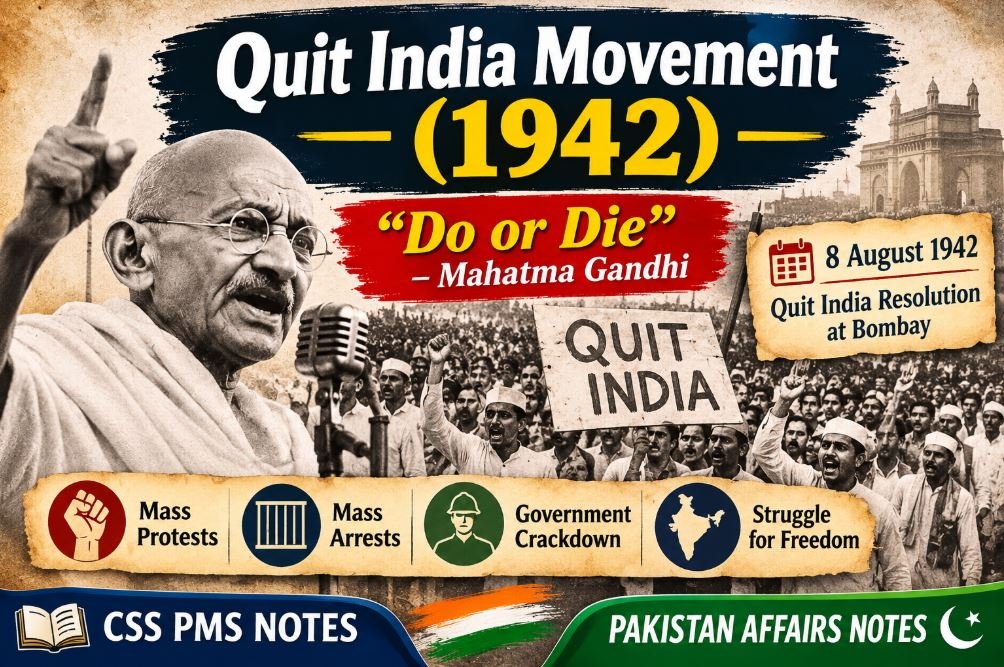
On 8 August 1942, the All-India Congress Committee passed the Quit India Resolution at Bombay (now Mumbai), calling for an end to British rule. Mahatma Gandhi gave the famous slogan “Do or Die” to encourage the people to struggle for independence.
The movement officially began on 9 August 1942, when the British Government arrested Gandhi and several other prominent Congress leaders.
The movement spread across different parts of India and involved demonstrations, strikes and other forms of protest. In several areas, protests also turned violent, resulting in a strong government crackdown.
The British authorities imposed restrictions, arrested thousands of activists and suppressed the movement through administrative and police action.
Reaction of the Muslim League to the Quit India Movement
The All-India Muslim League did not support the Quit India Movement. Quaid-e-Azam Muhammad Ali Jinnah and the Muslim League viewed the movement as a political campaign launched by Congress without first resolving the constitutional concerns of Muslims.
The League argued that transferring power to Congress without recognizing Muslim political demands could result in Hindu-majority domination.
In response to the Congress slogan of “Quit India”, the Muslim League popularized the slogan:
“Divide and Quit.”
Through this slogan, the Muslim League emphasized that the British should leave India only after recognizing the political rights and separate constitutional aspirations of Muslims.
The League continued its political campaign for Pakistan and maintained that the future constitutional settlement of India must take Muslim demands into consideration.
Significance of the Cripps Mission Plan 1942
The Cripps Mission Plan 1942 holds an important place in the constitutional history of British India and the Pakistan Movement.
Its major significance can be explained through the following points:
- Recognition of Constitutional Differences: The failure of the mission highlighted the fundamental differences between the political demands of Congress and the Muslim League.
- Recognition of Provincial Non-Accession: The proposals introduced the possibility that provinces could remain outside a future Indian Union, an important development in constitutional discussions.
- Strengthening of the Pakistan Demand: The Muslim League continued to emphasize that the future political arrangement must recognize the separate political identity and demands of Muslims.
- Failure of British Negotiations: The unsuccessful mission demonstrated the difficulty of achieving a constitutional settlement without agreement among the major political parties.
- Rise of Political Tensions: The failure of the proposals was followed by the Quit India Movement and increased political confrontation between the British Government and Congress.
- Development of Constitutional Debate: The proposals contributed to subsequent discussions about India’s independence, provincial autonomy and the future constitutional structure of the subcontinent.
Conclusion
The Cripps Mission Plan 1942 was an important attempt by the British Government to resolve India’s constitutional problems and secure Indian cooperation during the Second World War. Although the proposals offered Dominion Status after the war and introduced the right of provincial non-accession, they failed to satisfy the political demands of both the Muslim League and Congress.
The Muslim League rejected the proposals because they did not clearly recognize the demand for Pakistan, whereas Congress opposed the delay in independence and the possibility of India’s division. The failure of the mission further exposed the constitutional differences between the two major political organizations and contributed to the political developments that eventually led to the partition of British India in 1947.