
THE GOVERNMENT OF INDIA ACT, 1935
Introduction
The Government of India Act, 1935 was one of the most comprehensive constitutional reforms introduced by the British Government during its rule in the Indian subcontinent. It aimed to restructure the administrative and political system of British India by introducing provincial autonomy, proposing an All-India Federation and expanding the powers of legislative institutions.
The Act was passed by the British Parliament on 2 August 1935 and received Royal Assent on the same date. Its provincial provisions came into operation on 1 April 1937, while the proposed federal system was never implemented.
Although the Act introduced important constitutional changes, it retained substantial powers in the hands of the British Government, particularly the Governor-General and provincial Governors. It therefore failed to satisfy the political aspirations of major Indian political parties, including the All-India Muslim League and the Indian National Congress.
Historical Background of the Government of India Act, 1935
The political and constitutional developments of the early twentieth century played an important role in the introduction of the Government of India Act, 1935.
Several factors contributed to the demand for further constitutional reforms.
1. Failure of the Government of India Act, 1919
The Government of India Act, 1919, introduced constitutional reforms under the Montagu-Chelmsford scheme. However, it failed to provide substantial political authority to Indian representatives, particularly at the central level.
The introduction of Dyarchy in the provinces also created administrative difficulties because important departments remained under the control of the British-appointed Governors.
As a result, Indian political leaders demanded greater participation in government and more constitutional powers.
2. Rowlatt Act and Jallianwala Bagh Tragedy
The Rowlatt Act of 1919, which allowed the British authorities to detain individuals without ordinary trial safeguards, generated widespread opposition.
The situation became even more serious after the Jallianwala Bagh massacre on 13 April 1919, when British troops under General Reginald Dyer opened fire on an unarmed gathering in Amritsar.
These incidents increased political dissatisfaction and weakened public confidence in British constitutional promises.
3. Simon Commission (1927)
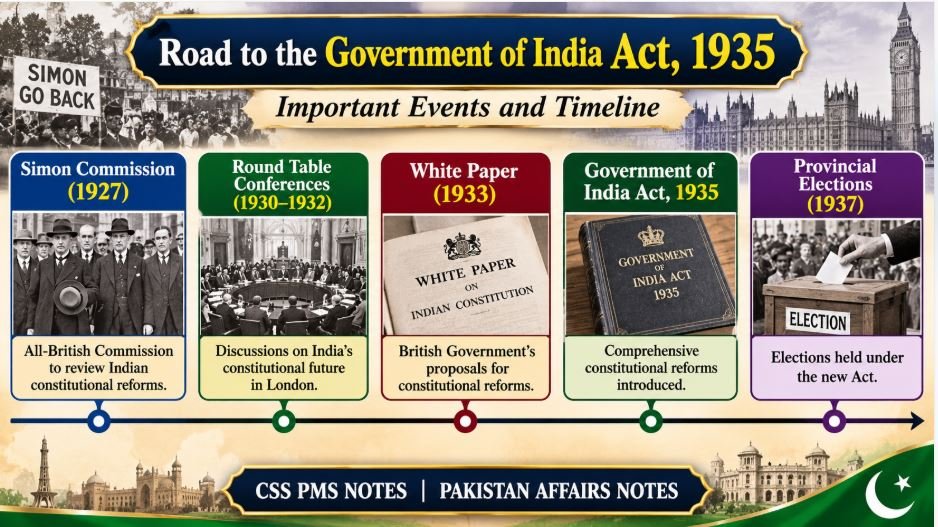
In 1927, the British Government appointed the Simon Commission to examine the working of the Government of India Act, 1919, and recommend further constitutional reforms.
The commission consisted entirely of British members, with no Indian representation. Consequently, major Indian political organizations boycotted it under the slogan “Simon Go Back”.
The commission submitted its report in 1930, recommending further constitutional changes, including greater provincial autonomy.
4. Round Table Conferences (1930–1932)
The British Government organized three Round Table Conferences in London between 1930 and 1932 to discuss India’s constitutional future.
The conferences addressed several important issues, including:
- Federal structure of India.
- Provincial autonomy.
- Representation of religious and political minorities.
- Separate electorates.
- Constitutional safeguards.
- Political rights of Indian communities.
Although the conferences produced several proposals, disagreements among Indian political parties and the British Government prevented the achievement of a comprehensive constitutional settlement.
5. Publication of the White Paper (1933)
Following the Round Table Conferences, the British Government published a White Paper in March 1933 containing proposals for constitutional reforms in India.
These proposals were examined by a Joint Select Committee of the British Parliament, chaired by Lord Linlithgow. After reviewing the recommendations, the committee prepared a report that provided the basis for the proposed legislation.
The resulting Bill was debated and passed by the British Parliament in 1935.
The Government of India Act, 1935
The Government of India Act, 1935, introduced a new constitutional framework for British India. It was designed to establish a federal structure, increase provincial authority and reorganize the relationship between the central and provincial governments.
The Act contained 14 parts and 10 schedules, making it one of the most detailed constitutional legislations introduced by the British Parliament.
Its major provisions were divided into two principal constitutional arrangements:
- Provincial Government and Provincial Autonomy.
- Proposed All-India Federation and Federal Government.
The provincial system became operational on 1 April 1937. However, the federal scheme could not be implemented because the required number of princely states did not accede to the proposed federation.
Salient Features of the Government of India Act, 1935
The major features of the Act can be discussed under the following headings.
A. Provincial Autonomy
One of the most important features of the Government of India Act, 1935, was the introduction of provincial autonomy.
Under the previous constitutional arrangement, the system of Dyarchy had divided provincial subjects into reserved and transferred categories. The 1935 Act abolished this system and introduced a more responsible form of provincial government.
The major provisions were:
1. Abolition of Dyarchy in Provinces
The system of Dyarchy introduced under the Act of 1919 was abolished at the provincial level. Provincial ministers were given greater responsibility for administering government departments.
2. Provincial Autonomy
The provinces were given greater administrative and legislative authority. They were recognized as separate constitutional units with their own governments and legislatures.
However, provincial autonomy was not absolute because Governors retained special discretionary and reserve powers.
3. Responsible Government
A parliamentary system of government was introduced in the provinces. Ministers were appointed from among the elected members of provincial legislatures and were collectively responsible to those legislatures.
4. Council of Ministers
Each province was provided with a Council of Ministers to assist and advise the Governor in administering provincial affairs.
However, the Governor could exercise special powers in certain matters and was not always bound by ministerial advice.
5. Division of Legislative Powers
The Act divided legislative subjects into three separate lists:
- Federal List: Subjects under the authority of the proposed central government.
- Provincial List: Subjects assigned to provincial governments.
- Concurrent List: Subjects on which both federal and provincial legislatures could make laws.
In cases of conflict concerning concurrent subjects, federal legislation generally prevailed.
6. Eleven Provinces
British India was organized into eleven Governor’s provinces:
- Bengal
- Bombay
- Madras
- United Provinces
- Punjab
- Bihar
- Assam
- Central Provinces and Berar
- North-West Frontier Province (NWFP)
- Sindh
- Orissa
Sindh was separated from the Bombay Presidency, while Orissa became a separate province.
7. Special Powers of Governors
Despite the introduction of provincial autonomy, Governors retained considerable authority.
They were given special responsibilities and discretionary powers relating to matters such as minority protection, public order and the administration of certain areas.
These powers limited the practical independence of elected provincial governments.
B. Federal Part of the Government of India Act, 1935
The Act proposed the establishment of an All-India Federation consisting of British Indian provinces and princely states that agreed to join it.
The proposed federation was intended to bring the different administrative units of India under a common constitutional framework.
Its major provisions were as follows:
1. Establishment of an All-India Federation
The Act proposed a federation comprising:
- British Indian provinces.
- Princely states that agreed to accede to the federation.
The accession of princely states was essential for the establishment of the proposed federal system.
However, the required conditions for accession were never fulfilled, and the federation did not come into operation.
2. Bicameral Federal Legislature
The proposed Federal Legislature was to consist of two houses:
a. Council of State (Upper House)
- It was to consist of 260 members.
- It was designed as a permanent chamber.
- Members were to serve nine-year terms.
- One-third of its membership was to retire every three years.
- Representation was to include British Indian provinces and princely states.
b. Federal Assembly (Lower House)
- It was to consist of 375 members.
- Out of these, 250 were to represent British India.
- The remaining 125 were to represent princely states.
- Its normal term was five years, subject to earlier dissolution.
3. Introduction of Dyarchy at the Centre
The Act abolished Dyarchy in the provinces but proposed introducing it at the central level.
Federal subjects were divided into two categories:
- Reserved Subjects: These included defence, external affairs, ecclesiastical affairs and the administration of tribal areas. They were to remain under the control of the Governor-General, assisted by appointed councillors.
- Transferred Subjects: These were to be administered by ministers appointed by the Governor-General who would be responsible to the Federal Legislature.
This arrangement was intended to provide limited ministerial participation while retaining British control over important national matters.
4. Powers of the Governor-General
The Governor-General was given extensive powers under the proposed federal system.
These included:
- Control over reserved subjects.
- Special discretionary powers.
- Authority to appoint ministers.
- Powers relating to financial administration.
- Emergency and constitutional responsibilities.
These provisions ensured that the British Government retained substantial influence over the central administration.
5. Division of Legislative Powers
The Act established three legislative lists to distribute authority between the federal and provincial governments.
The arrangement was designed to clarify the responsibilities of different levels of government and establish a federal constitutional structure.
Residuary legislative powers were placed under the authority of the Governor-General.
6. Establishment of the Federal Court
The Act provided for the establishment of a Federal Court to interpret the constitutional provisions and resolve disputes between the proposed federal and provincial governments.
The Federal Court was established in 1937 and began functioning on 1 October 1937.
It played an important role in the development of constitutional jurisprudence in British India.
C. Other Important Features of the Act
Apart from provincial autonomy and the proposed federal system, the Government of India Act, 1935, introduced several other important changes.
1. Extension of the Franchise
The Act expanded the number of people eligible to vote. However, voting rights were still based on qualifications such as property, taxation, education and other eligibility conditions.
Therefore, universal adult suffrage was not introduced.
2. Separate Electorates
The system of separate electorates was retained and extended to certain communities and groups.
This arrangement allowed different communities to elect representatives through their respective electoral systems.
3. Establishment of the Federal Court
The Federal Court was established in 1937 to deal with constitutional disputes and interpret the provisions of the Act.
4. Separation of Burma
Burma was separated from British India with effect from 1 April 1937 and was administered as a separate British colony.
5. Establishment of the Reserve Bank of India
The Reserve Bank of India began operations on 1 April 1935 under the Reserve Bank of India Act, 1934. Its establishment formed part of the wider financial and administrative developments of this period.
An Appraisal and Criticism of the Government of India Act, 1935
Although the Government of India Act, 1935, introduced significant constitutional changes, it failed to satisfy the political aspirations of major Indian political organizations.
Several political leaders criticized the Act because it retained substantial British control and did not provide genuine self-government.
1. Retention of British Control
The Act did not transfer complete political authority to Indian representatives. The British Government retained substantial control over important administrative, financial and constitutional matters.
2. Excessive Powers of Governors
Provincial Governors possessed special responsibilities and discretionary powers. These powers allowed them to interfere in the functioning of elected provincial governments.
3. Excessive Powers of the Governor-General
The Governor-General retained extensive authority over the proposed federal administration, particularly in defence, external affairs and other reserved subjects.
4. Failure of the Federal Scheme
The proposed All-India Federation never became operational because the required number of princely states did not accede to it.
As a result, the federal structure remained unimplemented.
5. Limited Franchise
Although the number of eligible voters increased, the right to vote remained restricted by property, educational and other qualifications.
The majority of the population continued to remain outside the electoral system.
6. Continuation of Communal Representation
The retention and extension of separate electorates continued to organize political representation along communal lines. This arrangement remained a subject of political disagreement.
7. No Immediate Dominion Status
The Act did not provide immediate Dominion Status or complete independence to India. Ultimate constitutional authority continued to rest with the British Parliament.
8. Limited Democratic Accountability
Although provincial ministers were made responsible to provincial legislatures, the special powers of Governors and the Governor-General restricted the functioning of a fully responsible democratic system.
Political Reactions to the Government of India Act, 1935
The major Indian political organizations expressed reservations about the Act, although their objections were based on different political concerns.
Reaction of the All-India Muslim League
The Muslim League criticized the Act because it did not provide sufficient constitutional safeguards for Muslim political interests.
The League was particularly concerned about the proposed federal structure, the powers of the central government and the need to protect Muslim representation in a future constitutional arrangement.
Quaid-e-Azam Muhammad Ali Jinnah also expressed strong criticism of the Act, describing it as fundamentally unacceptable in its existing form.
Reaction of the Indian National Congress
The Indian National Congress also rejected the Act as an adequate solution to India’s constitutional demands.
Congress objected to the extensive powers of the British-appointed Governors and Governor-General, the absence of full independence and the failure to establish a genuinely responsible government at the centre.
However, despite its opposition, Congress participated in the provincial elections held under the Act in 1937.
Provincial Elections of 1937
The Government of India Act, 1935, provided the constitutional framework for provincial elections held in 1937.
These elections were an important development in the political history of British India because they provided Indian political parties with an opportunity to participate in provincial administration.
The Indian National Congress secured a significant electoral victory and formed ministries in several provinces.
The All-India Muslim League also participated in the elections, but its electoral performance was weaker than that of Congress in many Muslim-majority areas.
The election results encouraged the Muslim League to strengthen its political organization and expand its support among Indian Muslims.
The Congress ministries formed in 1937 resigned in October and November 1939 following the Viceroy’s decision to declare India at war with Germany without consulting Indian political leaders.
These developments further influenced Muslim League politics and the constitutional debate that eventually led to the Lahore Resolution of 1940.
Significance of the Government of India Act, 1935
Despite its limitations, the Act played an important role in the constitutional and political development of the Indian subcontinent.
Its major contributions included:
- Provincial Autonomy: It introduced a more responsible system of provincial government and transferred greater administrative authority to elected ministers.
- Federal Constitutional Framework: It provided a detailed framework for a proposed federation between British Indian provinces and princely states.
- Division of Legislative Powers: It introduced three legislative lists to distribute powers between different levels of government.
- Federal Court: It established the foundation for constitutional judicial review through the Federal Court.
- Expansion of Electoral Participation: It increased the number of eligible voters and expanded participation in provincial elections.
- Political Development: It provided Indian political parties with opportunities to participate in provincial administration and gain experience in parliamentary government.
- Constitutional Influence: Several administrative and constitutional arrangements introduced under the Act influenced the constitutional development of both India and Pakistan after independence.
Conclusion
The Government of India Act, 1935, was a major constitutional development in the history of British India. It introduced provincial autonomy, proposed an All-India Federation, established a division of legislative powers and provided for the creation of a Federal Court.
However, the Act failed to provide genuine self-government because the British authorities retained extensive powers through the Governor-General and provincial Governors. Its proposed federal system also remained unimplemented.
Nevertheless, the Act played an important role in shaping the political and constitutional developments of the subcontinent. It provided the framework for the provincial elections of 1937 and influenced the political developments that eventually led to the independence and partition of British India in 1947.