Why Did Pakistan Join Western Defense Pacts? At What Cost?
Introduction
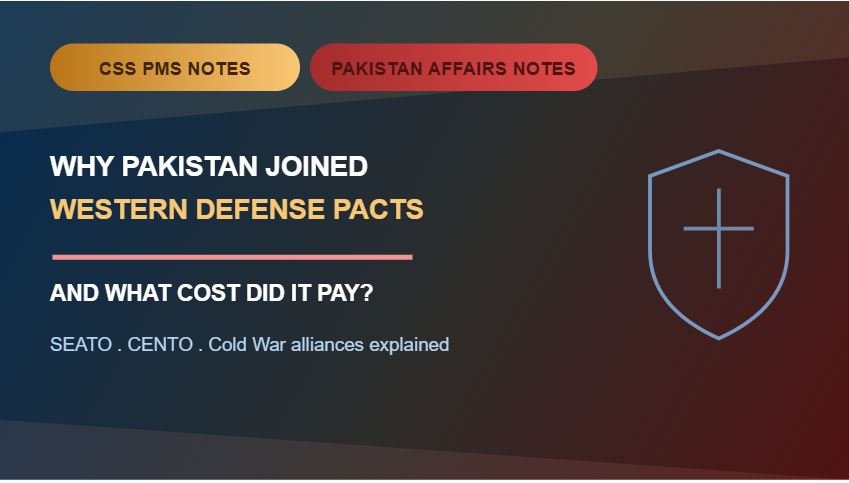
States entering regional or military pacts are usually driven by a mix of shared threat perception, ideological alignment, and material incentive. In the early Cold War, the newly independent Pakistan faced a specific security dilemma: a much larger, better-resourced India, an unresolved Kashmir dispute, and limited domestic capacity to build military and economic strength on its own. The United States, meanwhile, was constructing a global containment architecture against Soviet communism, and needed regional partners in South and Southeast Asia. These two sets of interests — Pakistan’s search for security and leverage against India, and Washington’s search for Cold War allies — converged to bring Pakistan into the Western alliance system.
Why Pakistan Joined
1. Security against India, not just communism
Officially, Pakistan’s pacts with the West were framed as anti-communist alliances. In practice, Pakistan’s primary motive was regional: to build military capability and international backing that could offset India’s larger conventional forces and strengthen its position on Kashmir.
2. Economic and military aid
Alliance membership came bundled with US military hardware, training, and economic assistance — resources Pakistan, as a resource-poor new state, badly needed for both defense and development.
3. International legitimacy and diplomatic weight
Formal alignment with major Western powers gave Pakistan a seat at the table in shaping regional security architecture, and diplomatic backing it otherwise lacked as a young state.
The Pact Architecture
Mutual Defense Assistance Agreement (May 1954)
Pakistan’s first formal defense agreement with the United States, laying the groundwork for subsequent multilateral commitments.
SEATO — Southeast Asia Treaty Organization (September 1954, Manila)
A collective defense treaty aimed at containing the spread of communism in Southeast Asia. Members included the United States, United Kingdom, France, Australia, New Zealand, the Philippines, Thailand, and Pakistan.
Baghdad Pact / CENTO — Central Treaty Organization (1955)
Formed in 1955 by Iraq, Turkey, Iran, Pakistan, and the United Kingdom. The US backed it diplomatically and militarily but avoided formal membership, wary of alienating Arab states it was courting separately. After Iraq withdrew in 1958–59 following its revolution, the pact was renamed CENTO, retaining Turkey, Iran, and Pakistan as regional members.
Pak–US Bilateral Agreement of Cooperation (1959)
Signed alongside similar agreements by Turkey and Iran, this bilateral pact was meant to reinforce CENTO’s defensive commitments and gave Pakistan an additional, direct security guarantee from Washington.
Colombo Conference (April 28 – May 2, 1954)
A separate, non-Western diplomatic track — Ceylon, India, Indonesia, Burma, and Pakistan (the “Colombo Powers”) met to discuss shared regional concerns, showing Pakistan was simultaneously engaging non-aligned diplomacy even as it moved toward Western alliances.
Bandung Conference (April 1955)
Representatives of 29 African and Asian nations met to promote decolonization, self-determination, non-aggression, and economic cooperation among the developing world — a forum that stood in some tension with Pakistan’s simultaneous membership in Western-led military pacts.
The Cost Pakistan Paid
1. Unreliable security guarantees
The core promise of these pacts — collective defense — was never honored when Pakistan needed it most. During the 1965 and 1971 wars with India, the US declined to intervene on Pakistan’s behalf, since the alliances were designed against communism, not India. This exposed a fundamental mismatch between why Pakistan joined (India) and why the US had built the system (the USSR).
2. Strained relations with the non-aligned and Arab world
Alignment with the West was viewed with suspicion by non-aligned Afro-Asian states and Arab nations wary of Cold War entanglement. It complicated Pakistan’s efforts to build solidarity with the broader Muslim and Global South bloc it also wanted influence within.
3. Domestic political distortion
Sustained US military and economic aid disproportionately strengthened Pakistan’s armed forces relative to its civilian institutions. Many scholars trace the military’s outsized role in Pakistani politics partly to this asymmetric flow of Cold War-era aid, which came with far fewer strings attached to democratic governance than to defense capacity.
4. A transactional, not a strategic, partnership
US support proved highly conditional — expanding sharply when it served American interests (e.g., the post-1979 Soviet invasion of Afghanistan, when President Reagan approved a $3.2 billion, five-year aid package including F-16 aircraft) and contracting just as sharply once those interests were served (aid was cut in the early 1990s over Pakistan’s nuclear program once the Soviet threat had receded). The same cycle repeated after 9/11, when sanctions were lifted as Pakistan became a “frontline state” in the war on terror.
5. Loss of strategic autonomy
Alliance membership tied Pakistan’s foreign policy choices to US Cold War priorities, at times limiting its diplomatic flexibility with the USSR, China (in the earlier period), and its non-aligned neighbors.
Decline of the Alliance System
By the 1960s, Cold War brinkmanship was easing, and CENTO and SEATO began to unravel — Iraq’s earlier exit, Egypt and Syria’s drift toward the Soviet Union, and the UK’s declining appetite for the commitments all weakened the framework. Pakistan formally left SEATO in November 1972, following the trauma of the 1971 war and the loss of East Pakistan, marking a symbolic end to the high point of its Western alliance era.
Conclusion
Pakistan joined Western defense pacts primarily to secure military and economic support against India, using anti-communism as the shared rationale that made alignment with Washington possible. The cost was a relationship that consistently prioritized US strategic interests over Pakistani security needs, distorted Pakistan’s civil-military balance, and strained ties with the non-aligned and Arab world — a trade-off whose consequences shaped Pakistani foreign policy and domestic politics well beyond the Cold War itself.