World Bank
The World Bank was conceived at the Bretton Woods Conference in July 1944, alongside the International Monetary Fund, but it was formally established in December 1945 when its founding member states signed the Articles of Agreement. It began lending operations in 1946, and its first loan — $250 million — went to France in 1947 for post-war reconstruction. Through the 1950s and 60s it focused on rebuilding war-torn economies and financing infrastructure; in the 1970s, under President Robert McNamara, its mandate shifted toward poverty reduction and development lending for the Global South. Since the 1980s, structural adjustment and market-oriented reform have shaped its lending philosophy, and over the last three decades it has increasingly partnered with NGOs, civil society, and environmental groups. Its headquarters remain in Washington, D.C.
The five institutions of the World Bank Group
| Institution | Established | Core function |
|---|---|---|
| IBRD – International Bank for Reconstruction and Development | 1945 | Loans to middle-income and creditworthy low-income governments |
| IDA – International Development Association | 1960 | Grants and concessional credit to the poorest countries |
| IFC – International Finance Corporation | 1956 | Private-sector investment and financing |
| MIGA – Multilateral Investment Guarantee Agency | 1988 | Political risk insurance for foreign investors |
| ICSID – International Centre for Settlement of Investment Disputes | 1966 | Arbitration of investor–state disputes |
a) IBRD
Focused on reconstruction and infrastructure development, IBRD lends to creditworthy governments, often paired with Structural Adjustment Programs (SAPs). Key areas include industrialization, dams and barrages, trade and transport networks, and port/airport infrastructure.
b) IDA
IDA is the World Bank’s concessional-financing arm for the world’s poorest countries, offering grants (non-repayable aid) and highly concessional credit (long repayment periods, low or zero interest). Its focus spans education, health, environmental sustainability, and employment generation.
c) IFC
The IFC is the largest global development institution dedicated exclusively to private-sector growth in developing countries. A stronger private sector expands employment, boosts domestic revenue, and attracts Foreign Direct Investment (FDI) — note this is FDI, not “Federal Direct Investment.”
d) MIGA
Created in 1988, MIGA promotes FDI into developing countries by offering political risk insurance and credit enhancement to investors and lenders, helping de-risk investment in markets that might otherwise be seen as too volatile.
e) ICSID
ICSID provides institutional machinery for the conciliation and arbitration of disputes between foreign investors and host states, offering a neutral forum outside domestic courts.
World Bank and Pakistan
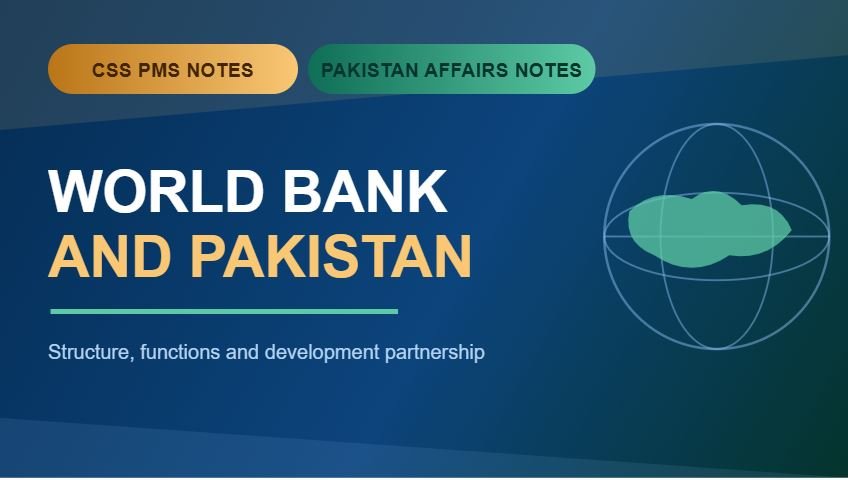
Pakistan has been a World Bank member and borrower since 1950, and the relationship has evolved from project-based lending into long-term strategic partnership. In 2026, Pakistan became the first country to sign the Bank’s new extended-format Country Partnership Framework (CPF) 2026–2035, worth roughly $20 billion in sovereign lending, with an additional ~$20 billion in expected private investment via the IFC — pushing the total package toward $40 billion over the decade. This marks a shift away from the Bank’s earlier five-year CPF cycles (such as 2021–2026) toward sustained, longer-horizon financing, built around six priorities: reducing child stunting, cutting learning poverty, climate and flood resilience, cleaner energy, fiscal space and public expenditure reform, and private investment growth.
Key areas of engagement:
i) Education
- Infrastructure development for improved learning environments
- Raising girls’ enrollment and retention rates
- Encouraging public–private partnerships in schooling
ii) Health
The World Bank Group supports Pakistan’s push toward Universal Health Coverage (UHC) — ensuring access to quality healthcare without financial hardship — through:
- Health infrastructure development
- Strengthening Basic Health Units (BHUs)
- Vaccination and immunization drives
- Nutrition and anti-malnutrition programs
iii) Social Safety Net
Support for Pakistan’s flagship cash-transfer program, the Benazir Income Support Programme (BISP), now operating under the broader “BISP – Kafaalat” umbrella.
iv) Agriculture
- Irrigation and water-infrastructure development
- Rehabilitation of major assets like the Tarbela Dam spillways, turbines, and canal realignment
v) Crop Diversification
- Promotion of genetically engineered, high-yield seed varieties
- Development of climate-resilient crops for harsh growing conditions
- Example: Pakistan’s import of the genetically modified rice variety IR-8 from India in the 1970s, which produced yields roughly five times higher than traditional varieties (part of the broader “Green Revolution”)
vi) Mechanized Farming
Promotion of drip irrigation, one of the most water- and nutrient-efficient delivery systems available — delivering resources directly to a plant’s root zone in precise amounts, reducing water waste and boosting yields while cutting fertilizer and energy costs.
vii) Trade and Transport
- Reconstruction of roads, tunnels, and bridges to ease connectivity
- Expansion of Special Economic Zones (SEZs)
- Support for broader industrialization strategy