
The electromagnetic spectrum is the complete range of electromagnetic waves, arranged in order of their wavelength or frequency. It extends from radio waves, which have the longest wavelengths and lowest frequencies, to gamma rays, which have the shortest wavelengths and highest frequencies. All of these waves travel at the speed of light (about 3 × 10⁸ m/s) in a vacuum and need no medium to propagate.
Key relationships in the electromagnetic spectrum
Every wave in the electromagnetic spectrum follows two simple equations:
- c = fλ, where c is the speed of light, f is frequency and λ is wavelength. A longer wavelength means a lower frequency.
- E = hf, where E is photon energy and h is Planck’s constant (6.63 × 10⁻³⁴ J·s). A higher frequency means more energy per photon.
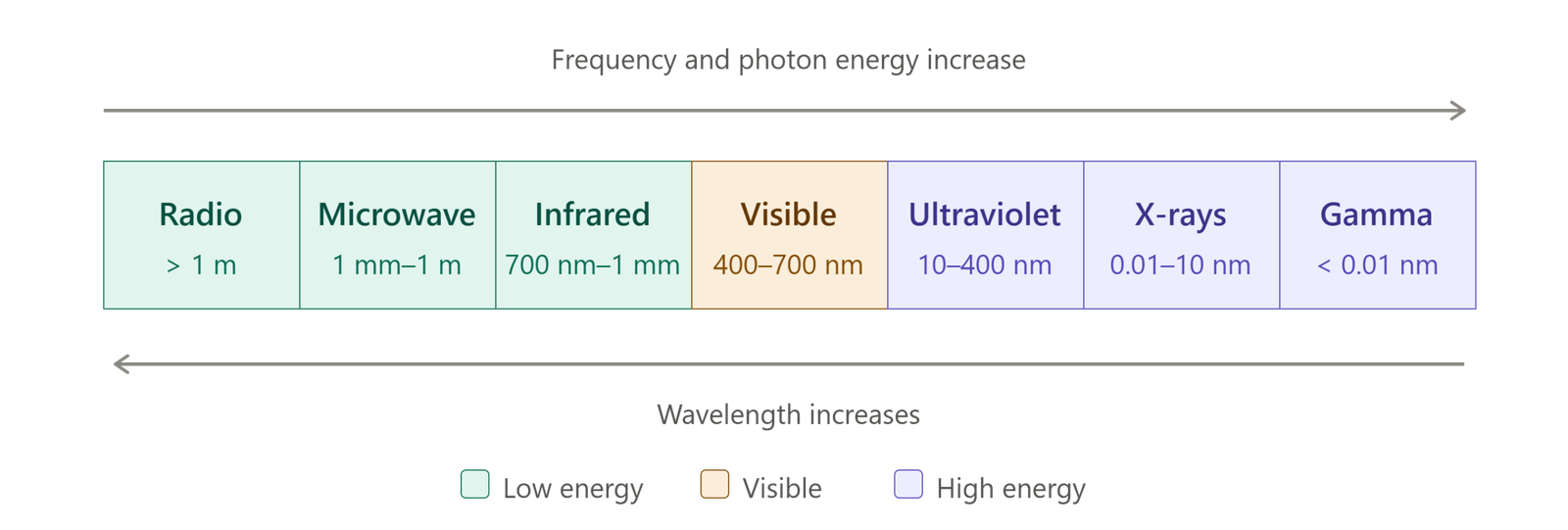
So radio waves carry the least energy per photon and gamma rays carry the most.
Regions of the electromagnetic spectrum
1. Radio waves
- Wavelength: longer than about 1 m.
- Source: antennas and electronic circuits, and natural sources such as lightning and stars.
- Uses: radio and TV broadcasting, mobile phones, Wi-Fi, Bluetooth and radar.
2. Microwaves
- Wavelength: about 1 mm to 1 m.
- Source: magnetrons, klystrons and satellite transmitters.
- Uses: microwave ovens, satellite communication, GPS and weather radar.
3. Infrared (IR)
- Wavelength: about 700 nm to 1 mm.
- Source: any warm object, including the human body and the Sun.
- Uses: thermal imaging, night-vision cameras, remote controls and fibre-optic communication.
4. Visible light
- Wavelength: about 400 nm to 700 nm, the only part human eyes can detect.
- Colours in order of increasing frequency: red, orange, yellow, green, blue, indigo, violet (the mnemonic VIBGYOR is used from violet to red).
- Uses: vision, photography, photosynthesis, lasers and optical instruments.
5. Ultraviolet (UV)
- Wavelength: about 10 nm to 400 nm.
- Source: the Sun, welding arcs and UV lamps.
- Uses: sterilizing water and surgical tools, detecting fake banknotes, and helping the body make vitamin D.
- Risk: overexposure can cause sunburn, eye damage and skin cancer. The ozone layer absorbs most harmful UV from the Sun.
6. X-rays
- Wavelength: about 0.01 nm to 10 nm.
- Source: X-ray tubes, where fast electrons strike a metal target.
- Uses: medical imaging of bones and teeth, CT scans, airport security and crystal structure analysis.
7. Gamma rays
- Wavelength: shorter than about 0.01 nm.
- Source: radioactive nuclei, nuclear reactions and cosmic events such as supernovae.
- Uses: cancer radiotherapy, sterilizing medical equipment and food, and studying the universe.
- Risk: they are highly penetrating and ionizing, so thick lead or concrete shielding is needed.
Common properties of all electromagnetic waves
- They are transverse waves, with electric and magnetic fields perpendicular to each other and to the direction of travel.
- They need no medium and can travel through a vacuum.
- They all travel at 3 × 10⁸ m/s in a vacuum.
- They carry energy and momentum and are not deflected by electric or magnetic fields.
- They show reflection, refraction, diffraction, interference and polarization.
Ionizing and non-ionizing radiation
| Type | Regions | Effect |
|---|---|---|
| Non-ionizing | Radio, microwave, infrared, visible | Low energy. It mainly heats or excites molecules and cannot remove electrons from atoms. |
| Ionizing | Upper ultraviolet, X-rays, gamma rays | High energy. It can knock electrons out of atoms and damage living cells or DNA. |
Importance of the electromagnetic spectrum
- Communication: radio, TV, mobile networks, satellites and fibre optics.
- Medicine: X-ray imaging, UV sterilization, infrared therapy and radiotherapy.
- Astronomy: telescopes that observe different regions of the electromagnetic spectrum reveal stars, galaxies and black holes that visible light alone would not show.
- Industry and security: quality inspection, night vision, scanners and remote sensing.
Conclusion
The electromagnetic spectrum is a continuous family of waves that differ only in wavelength, frequency and energy. Radio waves sit at the long-wavelength, low-energy end, and gamma rays at the short-wavelength, high-energy end, with visible light as a narrow band in between. Understanding the electromagnetic spectrum underlies modern communication, medicine, astronomy and technology.
FAQs on the Electromagnetic Spectrum
1. What is the electromagnetic spectrum?
The electromagnetic spectrum is the complete range of electromagnetic waves, arranged by wavelength, frequency and energy. It runs from radio waves to gamma rays.
2. What are the seven types of waves in the electromagnetic spectrum?
In order of increasing frequency, they are radio waves, microwaves, infrared, visible light, ultraviolet, X-rays and gamma rays.
3. Which wave has the longest wavelength in the electromagnetic spectrum?
Radio waves have the longest wavelength, longer than about 1 meter, and the lowest frequency and energy.
4. Which wave has the highest energy in the electromagnetic spectrum?
Gamma rays have the highest frequency and energy, and the shortest wavelength, less than about 0.01 nm.
5. What is the speed of electromagnetic waves?
All electromagnetic waves travel at about 3 × 10⁸ m/s in a vacuum, the speed of light.
6. Do electromagnetic waves need a medium to travel?
No. They can travel through a vacuum, which is why sunlight reaches Earth through space.
7. What part of the electromagnetic spectrum can humans see?
Humans can see only visible light, with wavelengths of about 400 nm to 700 nm. It appears as the colours violet through red.
8. What is the relationship between wavelength and frequency?
They are inversely related, as given by c = fλ. When wavelength increases, frequency decreases.
9. Which electromagnetic waves are harmful?
High-energy waves such as ultraviolet, X-rays and gamma rays are ionizing and can damage cells and DNA with overexposure. Low-energy waves such as radio waves and visible light are non-ionizing and are generally safe at normal levels.
10. What are some uses of the electromagnetic spectrum?
- Radio waves: broadcasting and Wi-Fi
- Microwaves: ovens and satellite communication
- Infrared: remote controls and thermal imaging
- Visible light: vision and photography
- Ultraviolet: sterilization
- X-rays: medical imaging
- Gamma rays: cancer treatment
11. Are electromagnetic waves transverse or longitudinal?
They are transverse waves. The electric and magnetic fields oscillate at right angles to each other and to the direction of travel.
12. Why is the electromagnetic spectrum important?
It underlies communication, medicine, astronomy, industry and security technology, and it lets scientists study objects across the universe.